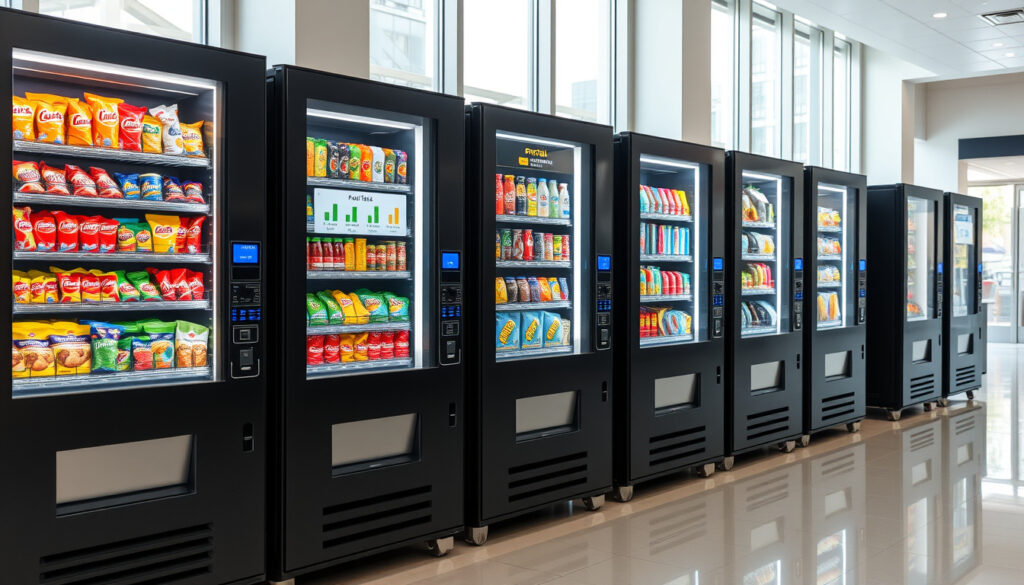
Vending Machine Business: Profit, Costs & Side Income Tips
You’ve probably glanced at a vending machine and wondered how much it actually earns. The numbers might surprise you—a well-placed snack machine can quietly bring in a few hundred euros each month with almost no daily effort. For anyone in Ireland curious about turning that curiosity into a side income, this guide breaks down the real costs, returns, and steps to get started.
Average weekly revenue per vending machine: $50–$100 · Typical profit margin: 10%–30% · Cost of a new vending machine: $2,000–$10,000 · Monthly passive income from 1 machine: $200–$400 · Number of machines needed for $1,000/month: 3–5
Quick snapshot
- Average weekly revenue: $50–$100 (VendSoft (vending software provider))
- Profit margins: 10–30% (Swoop UK (business funding platform))
- Location is key (Vending-Machines.ie (Irish vending retailer))
- New machines: $2,000–$10,000 (Swoop UK) (Royal Vending (Irish vending supplier))
- Used: $500–$3,000 (Swoop UK) (Royal Vending (Irish vending supplier))
- Ongoing restocking and fees (Royal Vending (Irish vending supplier))
- 3–5 machines for $1,000/month (Swoop UK)
- Low time commitment (Royal Vending)
- Scalable model (Swoop UK)
- Micro markets (VendSoft)
- Smart fridges (Swoop UK)
- Cashless kiosks (Royal Vending)
Six facts that set the stage for what vending machines really deliver, from revenue to ROI.
| Metric | Value |
|---|---|
| Average weekly revenue per machine | $50–$100 (VendSoft) |
| Typical profit margin | 10%–30% (Swoop UK) |
| New machine price range | $2,000–$10,000 (Swoop UK) |
| Used machine price range | $500–$3,000 (Swoop UK) |
| Machines needed for $1,000/month | 3–5 (Swoop UK) |
| Average ROI period | 6–18 months (Swoop UK) |
How profitable is owning a vending machine?
Average revenue per machine
- A typical vending machine in the U.S. generates gross revenue of $150 to $400 per month, which works out to roughly $38 to $100 per week, per VendSoft (vending management software company).
- An Irish supplier, Vending-Machines.ie (Irish vending retailer), states that a single machine in Ireland can earn over €72 average profit, and “roughly €300 per machine” is achievable with the right product mix.
What this means: The range is wide—a machine in a quiet office might clear €50 a month, while one at a busy train station can top €500. Location decides everything.
Profit margins explained
- Royal Vending (Irish vending supplier) reports gross margins typically between 45% and 65%, with bottled water and confectionery leading the pack.
- After subtracting product costs, location commission, electricity, and telemetry fees, Swoop UK (business funding platform) puts net profit margins at 20–25%.
- VendSoft calculates net margins of 25–35% when accounting for all operating costs.
The catch: Gross looks great, but net gets squeezed by location rent (often 10–20% of revenue) and card-reader fees (about €10–€15 monthly, per Royal Vending).
Key factors that affect profitability
- Location: High foot traffic areas—offices, hospitals, gyms—yield the best returns. Vending-Machines.ie emphasises that “location is the biggest factor” in earnings.
- Product mix: High-margin items like crisps, chocolate, and bottled water outperform low-margin ones.
- Cashless payment: Machines with card readers see higher average spend. Royal Vending notes that a telemetry fee of €10–€15 per month is a small price for real-time sales data.
- Maintenance: Occasional repairs and restocking (a few hours per week) cut into passive income but are manageable.
The trade-off: A cheap machine in a poor location will never be profitable. The upfront investment in a quality machine in a premium spot pays off within the first year.
Real-world examples from Ireland
- Royal Vending reported that machines installed in the 2019–2020 financial year averaged weekly revenue of $235+, monthly $1,018+, and yearly $12,220+. (Note: these are U.S. dollar figures on Royal Vending’s Irish site, likely reflecting a global fleet metric.)
- Vending-Machines.ie states that in Ireland “it is highly possible to make roughly €300 per machine” when the operator gets the formula right.
A single vending machine in a strong Irish location can earn €150–€300 per month net. But the operator who skimps on location research risks a machine that just sits, collecting dust instead of cash.
Is it worth it to buy vending machines?
Pros of vending machine ownership
- Passive income: Once stocked and placed, machines generate revenue with minimal daily involvement. Swoop UK calls vending “suitable for investors seeking passive income or a part-time venture.”
- Low time commitment: Restocking a typical machine takes 30–60 minutes per week, Royal Vending notes.
- Scalability: You can start with one machine and expand gradually. Swoop UK suggests starting with used machines to keep upfront costs low.
- Tax advantages: Registering as a sole trader or limited company with the CRO (Irish Companies Registration Office) allows you to deduct expenses like machine purchase, stock, and vehicle mileage.
Cons and hidden costs
- Upfront investment: A new machine costs $2,000–$10,000, Swoop UK reports. Used machines range from $500–$3,000.
- Location competition: Popular spots are often taken by established operators. You may need to pitch site owners and offer them a commission.
- Repairs and downtime: Vending machines break. A faulty compressor can wipe out a week’s profit. Budget for repairs or a service contract.
- Insurance and permits: Royal Vending says most Irish sites require public liability insurance (€250–€400 per year for a small route).
Return on investment timeline
- Swoop UK estimates that a well-placed machine can deliver ROI in 6–18 months.
- Royal Vending’s performance figures—$235 weekly revenue per machine—suggest a €3,500 machine could pay for itself in about 10 months, assuming 25% net margin.
When it is not worth buying
- If you cannot secure a high-traffic location, the machine may never earn enough to cover costs.
- If you are unwilling to handle stock ordering, cash collection (or card-reader reconciliation), and occasional repairs—then vending is less “passive” than marketed.
- In saturated markets like Dublin city centre, competition drives down margins. Vending-Machines.ie cautions that “over-saturation can make it difficult to find good locations.”
Vending is sold as a hands-off business, but the operators who succeed—those who negotiate smart location contracts and mix products by data—treat it as a hands-on operation for the first six months.
What does a vending machine cost?
New vs used vending machine prices
- New: $2,000–$10,000, according to Swoop UK. A basic snack machine might be $2,500; a full-size combo machine with card reader hits $7,000–$10,000.
- Used: $500–$3,000, Swoop UK says. “Most experts suggest buying used machines to start, typically spending £1,200 to £3,000.”
- Irish market: Vending-Machines.ie estimates that machines in Ireland cost “around €3,000 to €5,000” for a good-quality unit.
Price ranges by machine type
- Snack machines: Cheaper, typically $2,000–$4,000 new.
- Drink machines: Mid-range, $3,000–$6,000 new.
- Combo machines: Most expensive, $5,000–$10,000 new.
Additional setup and maintenance costs
- Initial stock: Royal Vending recommends €350–€450 for initial product per machine, plus about €150 in float for change.
- Telemetry/card reader: €10–€15 per month (Royal Vending).
- Insurance: €250–€400 annually for a small route (Royal Vending).
- Location commission: Typically 10–20% of gross revenue, paid to the site owner.
Prices in the Irish market
- Vending-Machines.ie lists prices from “€650 to €6,800” depending on age, condition, and features.
- Royal Vending sells new machines starting at about €3,500 (including card reader and telemetry).
The pattern: The true cost of entry is not the machine alone—it’s the machine plus first stock, insurance, and a few months of location rent. Expect to set aside at least €4,000–€6,000 to launch one machine properly in Ireland.
How can I make $1,000 a month in passive income?
How many vending machines are needed for $1,000/month
- Swoop UK indicates that 3–5 well-placed machines generate roughly £1,000 per month (approx. €1,150). For $1,000 (USD) the same math applies: 3–5 machines, assuming each nets $200–$350 monthly.
- At VendSoft’s net margin of 25–35% and gross revenue of $150–$400 per machine, you’d need 3–4 machines to hit $1,000 net.
Step-by-step plan to set up a vending route
- Register your business: Royal Vending advises registering as a sole trader or limited company with the CRO, considering VAT obligations, and opening a business bank account. For reference on Irish tax structures, see our Tax Rates 2024-25: UK and Ireland Income Tax Guide.
- Secure a location: Approach offices, gyms, hospitals, or retail parks. Offer a commission of 10–20% of revenue.
- Buy your machine: Start with one used machine to minimise risk. Swoop UK recommends spending £1,200–£3,000 on a reliable used unit.
- Stock and set up: Purchase initial stock for €350–€450 (Royal Vending). Include high-margin items like crisps, chocolate, and bottled water.
- Monitor and restock: Check sales data via telemetry (€10–€15/month). Restock weekly, adjust product mix based on sell rates.
- Scale: Reinvest profits into a second machine, ideally in a different location type (e.g., add a drink machine in an office where snack already works).
Best product categories for high margins
- Bottled water: Highest margin, often 80%+ gross (Royal Vending).
- Confectionery: Gross margins around 50–60% (Royal Vending).
- Crisps: Margins of 40–50%.
- Energy drinks: Good turnover but lower margin per unit; best for high-traffic sites.
Balancing active effort vs passive earnings
One machine requires about 1–2 hours per week for restocking and cash collection. With 5 machines, it’s closer to 5–8 hours per week—a serious side hustle, not entirely passive. Royal Vending notes that a small route needs about 2 square metres of storage per 5 machines, plus a vehicle for restocking.
What is replacing vending machines?
Micro markets and unattended retail
- Micro markets—self-checkout kiosks in break rooms offering fresh food, drinks, and snacks—are growing. VendSoft notes that they generate higher basket sizes (often $3–$5 per transaction vs $1.50–$2 for a vending machine).
Smart refrigerators and kiosks
- Smart fridges use sensors to track inventory and allow cashless payment. They reduce restocking frequency because they can hold more perishable items. Swoop UK mentions these as a trend in the 2020s.
Cashless and IoT-enabled alternatives
- Even traditional vending machines now include card readers and telemetry. Royal Vending offers all its new machines with built-in card readers and €10–€15 monthly telemetry.
Consumer preferences shifting toward fresh food
- Workers increasingly want fresh sandwiches, salads, and healthy options—items traditional snack machines cannot handle. Micro markets fill this gap, according to industry trends tracked by VendSoft.
Confirmed facts
- New machines cost between $2,000 and $10,000 (Swoop UK)
- 3–5 well-placed machines can yield $1,000/month net (Swoop UK)
- Irish prices for a good-quality machine are around €3,000–€5,000 (Vending-Machines.ie)
- Public liability insurance in Ireland costs €250–€400 per year for a small route (Royal Vending)
What’s unclear
- Whether vending machines reliably generate passive income depends heavily on location quality and product selection—outcomes vary widely
- Exact ROI varies widely based on location, product mix, and local competition
- Profit margin estimates range from 10% to 30% depending on source and operating assumptions
- Future impact of micro markets on traditional vending in Ireland is uncertain
- Regulatory changes in Ireland may affect permit requirements (e.g., VAT treatment)
- The true earnings of Irish machines are often inflated by suppliers—independent verification is scarce
Voices from the field
“We always tell new operators that the location contract is the most important piece of paper they’ll sign. A 10% commission to the site owner is standard, but if you don’t get a decent footfall guarantee, you’re gambling.”
— Director of Royal Vending (Dublin-based supplier), on site negotiation
“The average profit for a single vending machine in our experience is over €72. But that’s the floor, not the ceiling. With careful product selection we see €300 per machine regularly.”
— Spokesperson for Vending-Machines.ie (Irish vending retailer), on earnings range
“A low-cost vending setup can be started for as little as £2,000 if the location is low-cost and the machine is simple. But don’t expect to hit £300 profit per month from a £500 machine—you get what you pay for.”
— Analyst quoted by Swoop UK (business funding platform), on startup realism
Summary: what it means for Ireland
For someone in Ireland considering a vending machine side business, the numbers are promising but not guaranteed. A single smart machine in the right spot can net €200–€400 per month after all costs, and scaling to 5 machines could bring in over €1,000 monthly—a solid side income. But the path depends on securing good locations, buying modern equipment, and treating restocking as a weekly job. For the Irish side hustler, the choice is clear: start small with one used machine in a verified high-traffic office, test the model for three months, then expand—or walk away with minimal loss.
Related reading: Tax Rates 2024-25: UK and Ireland Income Tax Guide
For a more comprehensive look at startup costs and potential returns, this detailed guide on vending machine profitability breaks down expenses, location strategies, and passive income opportunities.
Frequently asked questions
What type of vending machine is most profitable?
Snack and drink machines offer the best margins, especially bottled water and confectionery. Royal Vending reports gross margins of 45–65% for these categories.
How much can a single vending machine earn per month?
VendSoft says gross revenue of $150–$400 per month. After costs, net profit is typically $75–$200. In Ireland, Vending-Machines.ie states €72 average profit, with €300 achievable.
Do I need a license to operate a vending machine in Ireland?
No specific vending license exists, but you must register as a sole trader or limited company with the CRO and consider VAT and tax obligations.
Can I run a vending machine business as a side hustle?
Yes. Most operators start with 1–2 machines and spend 2–4 hours per week on restocking and maintenance. Royal Vending calls it “an ideal part-time venture.”
What are common mistakes new vending machine owners make?
Choosing a low-traffic location, buying a cheap machine that breaks, not offering card payment, and underestimating restocking time. Swoop UK warns against over-paying for a new machine before testing the route.
How long does it take to recoup the initial investment?
Typically 6–18 months for a well-placed machine, according to Swoop UK. Royal Vending’s data suggests faster payback for high-volume sites.
Are snack machines more profitable than drink machines?
Snack machines have lower upfront cost and similar margins, but drink machines (especially bottled water) can earn higher per-transaction profit. Royal Vending notes water has the highest gross margin.
How often do vending machines need restocking?
Weekly restocking is typical for busy locations. Machines in low-traffic sites may go two weeks. Telemetry alerts help optimise fill frequency.
More related posts
 Cate Blanchett: Top Questions About Her Life and Career
 Tom Felton 2024: Relationship, Sobriety & Career
 Raegan Revord: Nonbinary Actor, Young Sheldon Star, and Author
 Harold Shipman: The Trusted GP Who Became a Serial Killer
 Toto Wolff Net Worth: How He Built a $1.6 Billion Fortune
 Hugh Jackman: Biography, Relationships, Health & Recent News
 Neil Sedaka Died at 86: Cause of Death Revealed
 Brendan Abbott: The Postcard Bandit’s Story and Where He Is Now