50 Pounds to KG – Exact Conversion and Luggage Guide
Converting 50 pounds to kilograms results in exactly 22.6796185 kg using the internationally recognized conversion factor. This calculation matters whether you’re packing for international travel, tracking gym progress, or working across imperial and metric measurement systems.
Understanding the precise relationship between pounds and kilograms becomes essential when airline baggage policies, international shipping requirements, or scientific measurements demand accuracy. The factor 0.45359237 forms the foundation of all pound-to-kilogram conversions worldwide.
Multiple industries rely on this exact conversion daily, from aviation weight restrictions to nutritional labeling. Getting the math right prevents unexpected fees, compliance issues, or measurement discrepancies in professional and personal contexts alike.
What is 50 Pounds in Kilograms?
When converting 50 pounds to kilograms, the result is 22.6796185 kg exactly. This figure derives from the standardized international conversion factor that has remained fixed since the 1959 international yard and pound agreement between the United States and United Kingdom.
The conversion factor of 0.45359237 applies universally to all avoirdupois pound measurements, making 50 lb to kg a straightforward mathematical calculation rather than an approximation.
22.6796185 kg
Luggage limit
18.143695 kg
Carry-on range
27.215542 kg
Checked bag
0.45359237 kg
Base unit
- Exact conversion: 50 lb × 0.45359237 = 22.6796185 kg
- For quick estimates: divide by 2.2046 to approximate kilograms
- The factor derives from the international avoirdupois pound definition
- 50 lb represents the common maximum checked luggage weight for many airlines
- Gym equipment often rounds this to 22.68 kg for practical display purposes
- Different rounding conventions (22.6796 vs 22.6796185) don’t affect accuracy significantly
| Pounds (lb) | Kilograms (kg) | Kilograms + Grams |
|---|---|---|
| 30 lb | 13.6078 kg | 13 kg 608 g |
| 40 lb | 18.1437 kg | 18 kg 144 g |
| 50 lb | 22.6796 kg | 22 kg 680 g |
| 60 lb | 27.2155 kg | 27 kg 216 g |
| 1 lb | 0.4536 kg | 453 g 592 mg |
How to Convert Pounds to KG (Formula and Steps)
Understanding the Conversion Formula
The official formula for converting pounds to kilograms follows a simple multiplication: kg = lb × 0.45359237. This factor emerged from the 1959 international agreement that precisely defined the avoirdupois pound as exactly 0.45359237 kilograms.
Two primary methods exist for performing this calculation. The direct method multiplies the pound value by the conversion factor. The alternative method divides pounds by 2.20462262185, which represents the exact reciprocal of the conversion factor.
Both approaches yield identical results, though division proves slightly more convenient for mental arithmetic when approximate values suffice. For instance, dividing 50 by 2.2046 produces approximately 22.68 kg, matching the exact calculation within acceptable tolerance for everyday use.
Step-by-Step Conversion Process
The conversion process follows three straightforward steps. First, identify the pound value you need to convert—in this case, 50 pounds. Second, multiply that value by 0.45359237. Third, interpret the resulting figure as your answer in kilograms.
For the specific calculation of 50 pounds to kilograms: 50 × 0.45359237 = 22.6796185 kg. This represents the exact conversion using the internationally standardized factor established by NIST and the International Bureau of Weights and Measures.
To express this result in grams instead, multiply the kilogram value by 1000, yielding 22,679.6185 grams. This level of precision matters in scientific, commercial, and regulatory contexts where measurement accuracy directly impacts outcomes.
For rapid mental calculations, multiply pounds by 0.4536 or divide by 2.205. Using 50 ÷ 2.205 yields approximately 22.68 kg, which falls within 0.01 kg of the exact value—sufficient accuracy for most practical purposes like estimating luggage weight.
50 lbs to KG for Luggage and Weight Limits
Airline Baggage Weight Restrictions
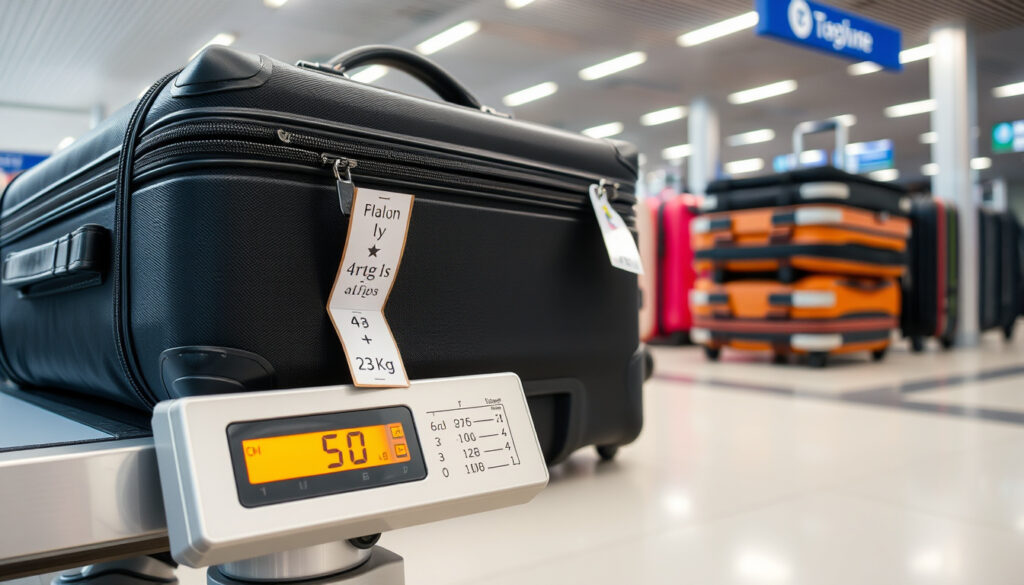
Most international airlines establish 50 pounds (22.7 kg) as the maximum weight for a single checked bag. Exceeding this threshold typically results in overweight baggage fees that vary by carrier and destination. Converting luggage weight to kilograms helps travelers avoid costly surprises at check-in counters.
European carriers often specify baggage limits in kilograms rather than pounds. A typical 23 kg allowance corresponds to approximately 50.6 pounds. Understanding this relationship prevents confusion when comparing airline policies across different measurement systems.
Budget airlines frequently impose stricter limits, sometimes capping checked baggage at 30 pounds (13.6 kg) or 40 pounds (18.1 kg). Converting these values to your preferred unit ensures you pack appropriately and avoid excess baggage charges that can exceed the value of the items being transported.
Carry-On Weight Considerations
Carry-on baggage limits typically range from 15 to 22 pounds (7 to 10 kg). The lower end of this spectrum accommodates lighter personal items, while the upper range covers full-day luggage or heavier laptop bags. Converting these limits helps travelers select appropriate carry-on bags and packing strategies.
When preparing for international flights, consider the combined weight of carry-on items including personal accessories. Many passengers overlook the weight of water bottles, reading materials, and secondary items that collectively contribute significant mass.
Weight limits differ substantially between carriers. Always verify specific airline policies before traveling, as budget carriers may enforce stricter limits than full-service airlines. Converting stated limits to your preferred unit provides a consistent comparison framework when evaluating options.
Related Conversions: 40 lbs, 60 lbs, and More to KG
Common Weight Conversions
Understanding conversions across the typical luggage weight range proves valuable for travel planning. A 40-pound bag converts to 18.1437 kg, falling comfortably within most carry-on weight limits. A 60-pound bag converts to 27.2155 kg, typically exceeding standard checked baggage allowances and triggering overweight fees.
30 pounds equals 13.6078 kg, representing a lightweight checked bag option or the upper range of strict carry-on limits. These conversions establish a practical reference framework for packing decisions across various travel scenarios.
Converting to Grams
For applications requiring granular precision, converting pounds to grams provides additional utility. 50 pounds converts to 22,679.6185 grams. This level of detail matters in scientific research, pharmaceutical manufacturing, and international trade where measurement precision directly affects product quality and regulatory compliance. For applications requiring granular precision, converting pounds to grams provides additional utility, and you can check out this handy tool for converting 50 pounds to kilograms at $USD to CAD live rate.
The conversion from pounds to grams follows a two-step process: first convert pounds to kilograms, then multiply by 1000. Both steps rely on the standardized factor of 0.45359237, ensuring consistency across all calculations.
Confusion between imperial and metric systems creates practical problems in luggage weighing, especially when using scales from different regions. Calibrate your equipment against known reference weights periodically to maintain accuracy across measurement systems.
Established Facts vs. Common Misconceptions
| Established Information | Information Requiring Verification |
|---|---|
| 1 lb = 0.45359237 kg exactly | Conversion factor has remained unchanged since 1959 |
| 50 lb = 22.6796185 kg (exact) | Some sources display rounded values (22.68 kg) |
| 50 lb = 22,679.6185 g (exact) | Individual airline policies vary from stated averages |
| 1 kg = 2.20462262185 lb (reciprocal) | Scale calibration intervals may vary by device type |
Imperial and Metric Measurement Systems
The pound belongs to the imperial system of measurement historically developed through British colonial influence and subsequently adopted as a standard in the United States. The kilogram, by contrast, represents the base unit of mass in the metric system, which evolved from French scientific standards during the late eighteenth century.
The coexistence of both systems creates practical challenges in international commerce, scientific research, and everyday applications. The National Institute of Standards and Technology maintains official conversion standards that enable precise communication across measurement traditions.
Most countries have officially adopted the metric system, though the United States continues using imperial units for many commercial and personal applications. This measurement duality necessitates accurate conversion tools for anyone working across international contexts.
Sources and Official Definitions
“The international avoirdupois pound is defined as exactly 0.45359237 kilograms.” — National Institute of Standards and Technology (NIST)
“The kilogram is defined by fixing the numerical value of the Planck constant h to be exactly 6.62607015 × 10⁻³⁴ J·s.” — International Bureau of Weights and Measures (BIPM)
These official definitions establish the conversion factor used universally in scientific, commercial, and educational contexts. The conversion factor derives from international agreements that ensure consistency across all applications.
Summary
Converting 50 pounds to kilograms yields exactly 22.6796185 kg using the internationally standardized factor of 0.45359237. This precise calculation applies to luggage weighing, fitness tracking, international shipping, and any context requiring accurate unit conversion.
For quick reference and additional conversion tools, consult our Lb to Kg conversion chart which provides comprehensive weight conversion resources for common measurements.
Frequently Asked Questions
What is 50 pounds to grams?
50 pounds equals 22,679.6185 grams. This conversion follows the two-step process of converting to kilograms (50 × 0.45359237) then multiplying by 1000 to obtain grams.
What is 50 pounds to lbs?
Converting 50 pounds to pounds results in 50 lbs, as this represents the same unit. The question reflects confusion between measurement systems rather than an actual conversion.
How many kilograms in one pound generally?
One pound equals exactly 0.45359237 kilograms. This factor, established by international agreement, applies universally to all avoirdupois pound measurements.
How do I convert pounds to kilograms without a calculator?
Divide the pound value by approximately 2.205 to estimate kilograms. For 50 pounds, 50 ÷ 2.205 ≈ 22.68 kg, which falls within 0.01 kg of the exact value.
What is the difference between mass and weight in this context?
Technically, the kilogram measures mass while the pound measures force in everyday use. However, conversion between pounds and kilograms treats both as weight values on Earth’s surface, which causes negligible practical differences.
Why do airlines use different weight limits?
Airlines establish weight limits based on aircraft capacity, fuel efficiency calculations, and operational safety margins. International carriers may specify limits in either pounds or kilograms depending on regional markets and regulatory requirements.
Can I use approximate conversions for medical measurements?
Medical contexts typically require exact conversions due to dosing precision requirements. Approximate values like 22.68 kg may introduce unacceptable error margins in pharmaceutical or clinical applications.
More related posts
 Go Karting Melbourne – Best Tracks, Prices and Booking
 Sarah Matulin: Marketing Specialist, Ben Roberts-Smith’s Partner
 Arshdeep Singh: Age, Stats, Height, Net Worth, and More
 Oncore by Clare Smyth Closing: Final Service 28 Feb 2026
 Money Heist: Season 6, True Story & Characters Explained
 Priscilla Hon: tennis ranking, coach, and career facts
 Kimi Antonelli: Facts vs Rumors About Mercedes F1 Rookie
 Jamie Oliver: Net Worth, Dyslexia, Family, Restaurant Collapse