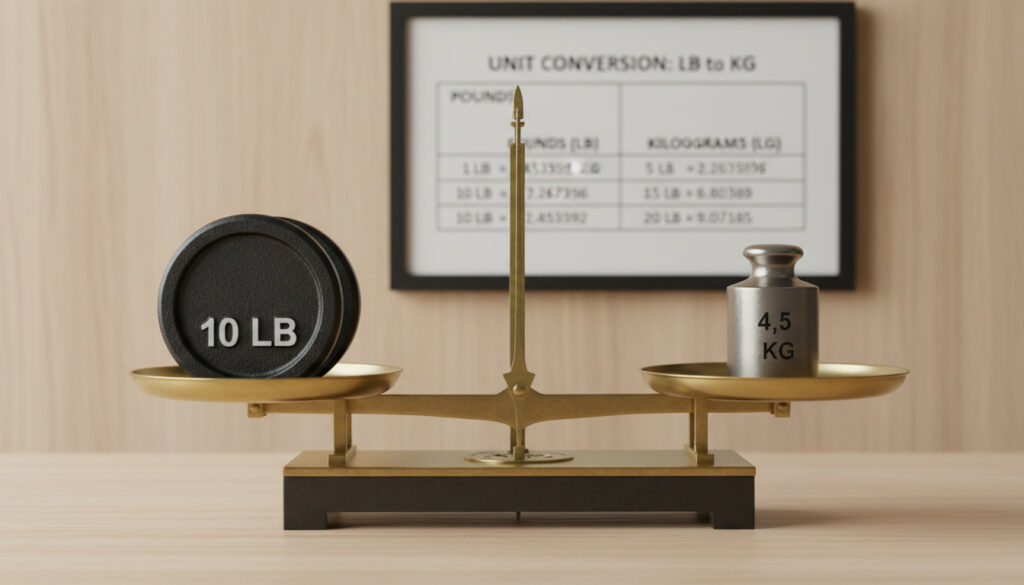
Lb to Kg – Exact Conversion Chart and Guide
One avoirdupois pound equals exactly 0.45359237 kilograms. This precise conversion factor, established by international treaty in 1959 and maintained by the National Institute of Standards and Technology (NIST) and the International Bureau of Weights and Measures (BIPM), governs every transition between imperial and metric mass measurements.
The distinction between pounds and kilograms extends beyond simple arithmetic. While the kilogram serves as the base unit of mass in the International System of Units (SI), used universally in scientific research and most global commerce, the pound persists in everyday American and British life—from gym weights to grocery scales. Understanding the exact relationship between these units prevents costly errors in international shipping, medical dosing, and athletic competition.
Despite the spread of metrication, the pound remains legally defined through its relationship to the kilogram, not through an independent physical standard. This dependency ensures that conversion calculations remain consistent worldwide, whether performed on a smartphone app or a laboratory balance.
What Is 1 Pound (lb) in Kilograms (kg)?
| Conversion Factor 1 lb = 0.45359237 kg (exact) |
Unit Origin lb: Imperial/US customary; kg: Metric/SI base unit |
| Common Use lb: US/UK body weight, groceries; kg: Global science, EU trade |
Quick Calculation Multiply lb by 0.4536 for practical accuracy |
- The exact factor 0.45359237 derives from the 1959 international yard-pound agreement ratified by BIPM signatories.
- NIST expresses this conversion as 4.535924 E-01 kg in scientific notation for compound unit calculations.
- Rounding to 0.45 kg creates approximately 0.8% error, unacceptable in pharmaceutical or engineering contexts.
- The avoirdupois pound differs from the troy pound used for precious metals (0.3732417 kg).
- The reciprocal relationship: 1 kg equals exactly 2.20462262185 lb, often rounded to 2.205 lb.
- CASIO calculators and engineering software reference NIST SP 811 for internal conversions.
- Medical and fitness devices typically display two decimal places (0.45 kg), while laboratory balances show five or more.
| Pounds (lb) | Kilograms (kg) | Common Context |
|---|---|---|
| 1 | 0.45359237 | Exact standard definition |
| 10 | 4.54 | Small bag of produce |
| 50 | 22.68 | Standard gym weight plate |
| 100 | 45.36 | Body weight segment |
| 150 | 68.04 | Average adult reference |
| 200 | 90.72 | Heavy luggage allowance |
How to Convert Pounds (lb) to Kilograms (kg)
The Exact Mathematical Formula
To convert pounds to kilograms with maximum precision, multiply the mass in pounds by 0.45359237. For reverse calculations, multiply kilograms by 2.20462262185. NIST Special Publication 811 codifies these factors for legal metrology and scientific research, ensuring that conversions maintain traceability to international standards.
Practical Shortcuts for Everyday Use
For mental math, dividing the pound value by 2.205 yields a result accurate within 0.001 kg for most practical purposes. Alternatively, multiplying by 0.4536 provides four-decimal precision suitable for cooking, fitness tracking, and luggage estimation. NIST approximate conversion cards often round to 0.45 kg per pound for rough estimates, though this introduces measurable error in cumulative calculations.
Engineering and pharmaceutical applications require the full eight-digit factor (0.45359237). For household cooking or gym progress photos, 0.4536 provides sufficient accuracy with easier mental calculation. CASIO scientific calculators store this value internally as 4.535924 E-01 kg.
Lb to Kg Conversion Chart and Table
Printable Reference Values
This table shows common conversion values derived from the exact NIST standard, rounded to two decimal places for practical readability:
| Pounds (lb) | Kilograms (kg) | Pounds (lb) | Kilograms (kg) |
|---|---|---|---|
| 10 | 4.54 | 100 | 45.36 |
| 20 | 9.07 | 150 | 68.04 |
| 50 | 22.68 | 160 | 72.57 |
| 75 | 34.02 | 200 | 90.72 |
| – | – | 250 | 113.40 |
Reading the Conversion Scale
Conversion charts vary in precision. Medical scales and laboratory balances typically display the full precision, while consumer luggage scales often round to the nearest 0.05 kg. Copying the table above ensures error margins remain below 0.01 kg up to 250 lb.
Common Lb to Kg Conversions (Examples)
Fitness and Body Weight Conversions
A person weighing 100 lb equals precisely 45.359237 kg, typically reported as 45.36 kg on digital scales. Similarly, 150 lb converts to 68.0389205 kg (68.04 kg rounded). For form-filling purposes, 160 lb equals approximately 72.57 kg. Visual conversion tutorials demonstrate these calculations step-by-step, showing how 15 kg equals roughly 33.08 lb and 24 kg equals approximately 52.92 lb.
Shipping and Luggage Calculations
International airlines often impose 23 kg limits per checked bag. This equals 50.70632026 lb, meaning a 50 lb suitcase remains safely under typical restrictions. Conversely, dividing 19 lb by 2.205 yields approximately 8.62 kg, useful for postal shipping calculations.
Most international carriers set checked luggage limits at 23 kg. Since 50 lb equals only 22.68 kg, packing to a 50 lb threshold provides a 0.32 kg safety margin under standard restrictions, avoiding overweight fees.
The avoirdupois pound (0.45359237 kg) differs significantly from the troy pound used for precious metals (0.3732417 kg). NIST documentation confirms that confusing these units results in a 17.6% error rate—critical when trading gold or pharmaceuticals.
How Did the Pound and Kilogram Standards Evolve?
- : France defines the kilogram as the mass of one cubic decimeter of water at melting point, establishing the metric system’s foundation.
- : The British Imperial system standardizes the avoirdupois pound through the Weights and Measures Act, though its mass varies slightly from modern definitions.
- : The international yard-pound agreement fixes the avoirdupois pound at exactly 0.45359237 kg, binding the US, UK, Canada, Australia, and other signatories to a unified standard maintained by BIPM.
- : The kilogram redefines itself via the Planck constant rather than a physical platinum-iridium cylinder, though the 0.45359237 kg/lb relationship remains legally fixed.
What Is Certain vs. Variable in Lb to Kg Conversion?
| Established Standards | Variable Practices |
|---|---|
| 1 lb = exactly 0.45359237 kg (NIST/BIPM) | Rounding to 0.45 kg for quick mental math (introduces 0.8% error) |
| Legal definition unchanged since 1959 international treaty | Display precision on consumer scales (0.1 kg vs 0.01 kg) |
| Avoirdupois pound distinct from troy/apothecary pounds | Colloquial use of “pound” for weight (force) rather than mass |
Why Do Some Countries Still Use Pounds Instead of Kilograms?
The persistence of imperial measurements in the United States and, to a lesser extent, the United Kingdom stems from historical inertia rather than technical superiority. The avoirdupois pound originated in medieval English wool trade, codified through generations of customary use. While British industry largely metricated following its 1965 decision, American retail and body-weight reporting retained pounds due to infrastructure costs and cultural preference.
Scientific communities worldwide, however, uniformly employ kilograms, creating a dual-system reality where international finance and AUD to JPY – Current Rate, History and Providers calculate in decimal metric while American cookbooks still measure ingredients in pounds. This dichotomy necessitates accurate conversion knowledge for anyone engaged in cross-border commerce or travel.
Where Do These Conversion Standards Come From?
The avoirdupois pound equals exactly 0.45359237 kg. This value stems from the 1959 international agreement redefining the pound in terms of the kilogram.
NIST Guide to the SI, Appendix B
The International Bureau of Weights and Measures maintains the SI base units, ensuring the pound-kilogram relationship remains consistent across global trade and scientific inquiry.
BIPM Standards Documentation
What Should You Remember About Lb to Kg?
Remember the exact factor 0.45359237 for precise work, or 0.4536 for daily convenience. Remember that 100 lb approximates 45.36 kg, and 1 kg equals roughly 2.205 lb. When traveling internationally, note that 23 kg airline limits correspond to approximately 50.7 lb, making the 50 lb mark a safe packing threshold. For culinary applications requiring Beef Brisket Slow Cooker – Tender in 8-10 Hours recipes, converting 8 lb of meat yields approximately 3.63 kg for metric kitchen scales.
Frequently Asked Questions
How many kilograms are in 200 pounds?
200 pounds equals exactly 90.718474 kilograms, typically rounded to 90.72 kg for practical use.
Is 1 pound exactly equal to 0.45 kilograms?
No. While 0.45 kg serves as a rough estimate used by NIST for approximate conversions, the exact value is 0.45359237 kg. Using 0.45 introduces an error of approximately 0.8 percent.
How do I convert kilograms back to pounds?
Multiply the kilogram value by 2.20462262185, or use 2.205 for quick mental calculations with minimal accuracy loss.
Why does my calculator show slightly different results?
Devices vary in decimal precision. Some use the full 0.45359237 factor, others use 0.4536 or 0.45. CASIO calculators reference NIST SP 811 standards internally.
Are pounds and kilograms measures of weight or mass?
Technically, both are units of mass. However, in everyday language, people use them to describe weight—the force exerted by gravity on that mass at sea level.
What is the difference between the pound and the kilogram?
The pound belongs to the imperial/US customary system with origins in medieval England, while the kilogram is the base unit of mass in the modern metric (SI) system used globally for science and most international trade.
How many kg is 150 lb exactly?
150 lb equals exactly 68.0389205 kg, which rounds to 68.04 kg on standard digital scales.
More related posts
 Royal Melbourne Show 2026: Ticket , Date & Worth It?
 Babe Ruth: Biography, Stats, Death, Net Worth, and Legacy
 David Harbour Allegations and Mental Health: What You Need
 Medicube Zero Pore Pad 2.0: Benefits, Usage & Reviews
 Dexter Keaton: Age, Husband, and Family Facts
 Michael Oher vs Tuohys: Blind Side Conservatorship
 Ken Miles: Le Mans Controversy, Death, and Ford Apology
 Murray Bartlett: Partner, Age, Roles, and Emmy Win Explained